Solar Generator Buying Guide: Panels, Input Limits and Recharge Math
A "solar generator" is a power station plus panels. The panels and the input limits decide how useful it is when the grid stays down.
We may earn a commission when you buy through links on this page, at no extra cost to you. This does not change which products we cover. How we make money.
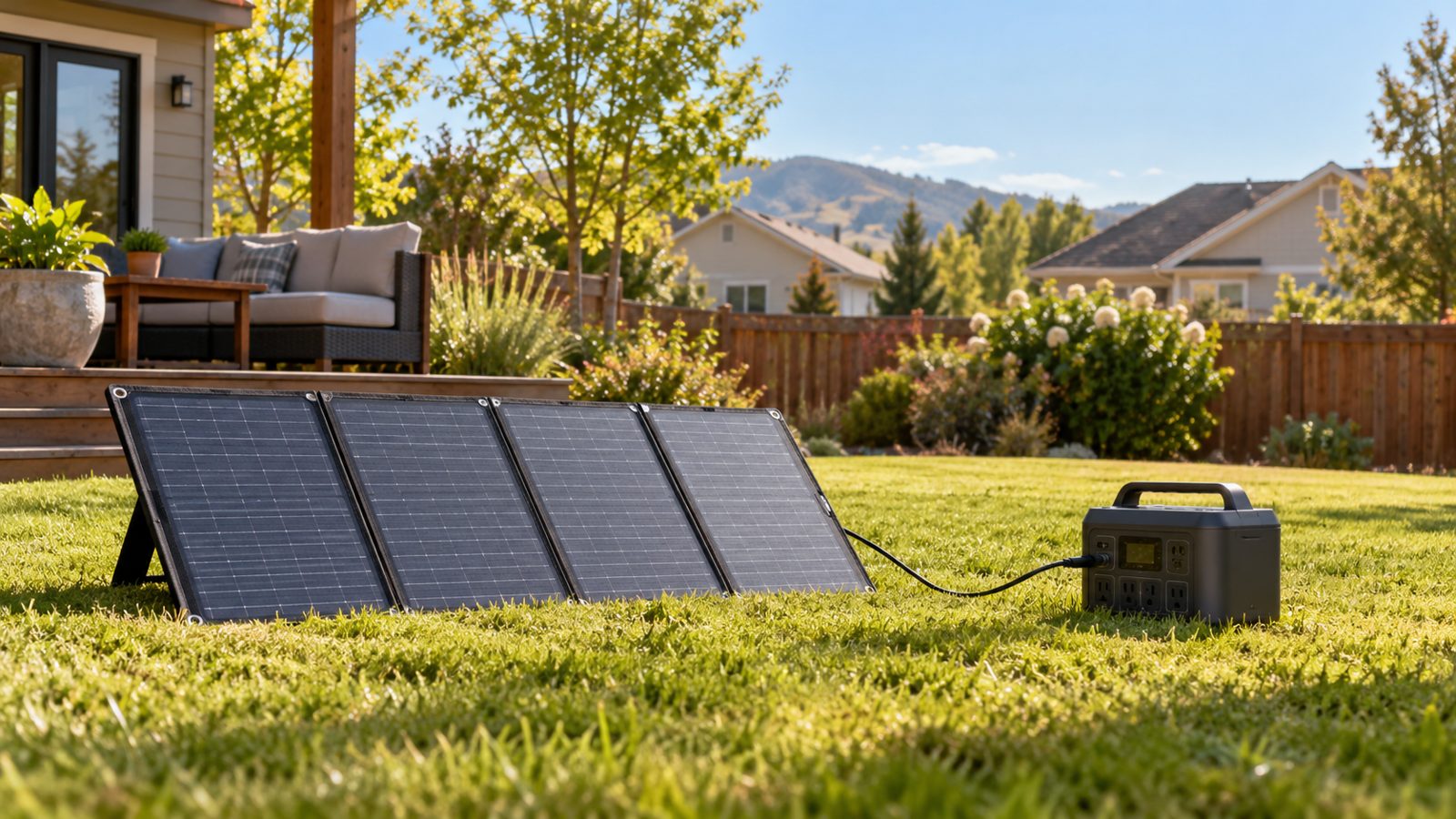
A battery runs out. Panels decide whether you can refill it tomorrow. That makes the solar side of a “solar generator” the part worth thinking hardest about, and it comes down to three numbers on the power station spec sheet.
The three solar specs that matter
- Maximum solar input in watts. The ceiling on how fast panels can refill the battery. Extra panel wattage beyond it does nothing in full sun.
- Voltage range. Every station lists one, such as 12–60V. Panels wired in series add their voltages together. Go over the maximum and you can damage the charge controller.
- Current limit in amps. Panels wired in parallel add their amps. Over the limit, the station caps the input.
Here is what our shortlist allows:
| Spec | Top pickEcoFlowDELTA 3 Plus | Anker SOLIXC1000 Gen 2 | BLUETTIAC180 | EcoFlowDELTA Pro 3 |
|---|---|---|---|---|
| Best for | Fast recharging and expandable home backup | Highest output in the 1kWh class | Budget-conscious buyers who want 1kWh+ | Whole-circuit home backup with 240V |
| Capacityhigher is better | 1,024 Wh1,024Wh (expandable to 5kWh) | 1,024 Wh1,024Wh | 1,152 Wh1,152Wh | 4,096 Wh★ Best4,096Wh (12kWh with 2 extra batteries) |
| Continuous AC outputhigher is better | 1,800 W1,800W (3,600W surge) | 2,000 W2,000W (3,000W peak) | 1,800 W1,800W (2,700W power lifting) | 4,000 W★ Best4,000W (6,000W X-Boost, 8,000W surge) |
| Max solar inputhigher is better | 1,000 W2 × 500W (1,000W total) | 600 W600W (60V max) | 500 W500W (12–60V) | 2,600 W★ Best2,600W total, 2 ports |
| Weightlower is better | 27.6 lb★ Best27.6 lb (12.5 kg) | Not listed | 35.3 lbAbout 35.3 lb (16 kg) | 113.5 lb113.5 lb (51.5 kg) |
| Wall charging | 1,500W (0–100% in 56 min, maker figure) | 1,600W (full in 49 min, maker figure) | 1,440W turbo (≈1.3–1.8 h) | — |
| Battery | LFP, 4,000 cycles to 80% | LiFePO4, 4,000 cycles to 80% | LiFePO4, 3,500+ cycles to 80% | LFP, 4,000 cycles to 80% |
| Price | Check price | Check price | Check price | Check price |
Specs from each manufacturer's US product page. Bars compare each spec against the best value in this table; they are not test scores. Prices change often, so we link out instead of quoting them.
BLUETTI lists a 12–60V range for the AC180, and Anker lists a 60V maximum for the C1000 Gen 2. For the EcoFlow units, read the voltage and amp limits for each input on EcoFlow’s spec page before you wire panels in series.
Recharge math you can trust
Panel labels assume lab conditions. Real panels on a lawn lose output to heat, angle, dust and haze. As a working rule, expect about 70% of rated watts at midday in clear weather, and much less in winter.
Hours to refill ≈ battery Wh ÷ (panel watts × 0.7)
| Battery | 200W panels | 400W panels | 800W panels |
|---|---|---|---|
| 1,024Wh | ~7.3 h | ~3.7 h | ~1.8 h* |
| 1,152Wh | ~8.2 h | ~4.1 h | ~3.3 h (500W input cap) |
| 4,096Wh | ~29 h | ~14.6 h | ~7.3 h |
*Only if the station accepts 800W. The DELTA 3 Plus takes up to 1,000W across two inputs.
A clear day gives you roughly four to six hours of strong sun, depending on where you live and the season. With 200W of panels, you will not refill a 1kWh station in one day. With 400W, you usually can.
Portable panels vs rigid panels
- Folding portable panels set up in minutes and pack into a closet. You can angle them toward the sun by hand, which recovers some of the loss.
- Rigid panels cost less per watt and last outdoors year-round, but need a mount or a stand.
If the system is for outages, portable panels are fine. If you want to cut your grid bill every day, rigid panels on a fixed ground mount make more sense.
Buying a bundle or mixing brands
Brand bundles take the guesswork out of connectors and voltage. Third-party panels often work too, as long as you:
- stay inside the station’s voltage range, including cold-morning voltage, which rises above the label;
- match the connector (MC4, XT60, DC8020 or the brand’s own), with an adapter if needed;
- respect the amp limit when you wire in parallel.
Our picks for solar charging
★Most solar input in the 1kWh class
EcoFlowDELTA 3 Plus
Best for: Fast recharging and expandable home backup
A 1,024Wh LiFePO4 unit with 1,800W AC output, 1,500W wall charging and the option to add extra batteries for up to 5kWh.
What we like
- Two solar inputs totaling 1,000W
- Expands with extra battery packs
- Quiet below 600W (30 dB, maker figure)
Watch out for
- At 27.6 lb, about 4 lb heavier than the Jackery
- Expansion batteries cost extra
★For long outages
EcoFlowDELTA Pro 3
Best for: Whole-circuit home backup with 240V
A 4,096Wh wheeled home battery with 4,000W continuous output (6,000W with X-Boost), 120V and 240V output, and expansion to 12kWh per unit.
What we like
- 240V output for well pumps and dryers
- Large solar input
- Scales to whole-home systems
Watch out for
- 113 lb: it rolls, you will not carry it
- Needs a transfer switch or panel kit for circuits
Not sure what size battery to pair with your panels? Start with the home backup sizing guide, then compare the batteries in our best portable power stations list.
Frequently asked questions
What is a solar generator?
A solar generator is a marketing name for a battery power station sold with portable solar panels. It makes no noise and no fumes. It stores sunlight as electricity in the battery and outputs it through standard outlets.
How many solar panels do I need for a 1,000Wh power station?
Panels rarely deliver their rated watts. In good sun, plan on about 70% of the label. To refill 1,000Wh in roughly 5 hours of good sun, you need around 300W of rated panels. In winter or under clouds, plan for more panels or longer refills.
Can I connect more solar panels than the power station input limit?
You can connect panels rated above the watt limit in some cases, because the charge controller caps the power. You must never exceed the maximum input voltage. Check the volts and amps on the station spec sheet before you wire panels in series or parallel.
Do I need a solar generator or a gas generator?
A gas generator gives more power per dollar for long outages but needs fuel, runs loud and must stay outdoors because of carbon monoxide. A solar generator runs indoors, makes no exhaust and refills free, but it stores less energy. Many households pair a battery with a small generator.