Best Portable Power Station for Camping and RVs (2026)
On the road, weight, car charging and fan noise matter as much as capacity. Here is how four popular 1kWh units stack up.
We may earn a commission when you buy through links on this page, at no extra cost to you. This does not change which products we cover. How we make money.
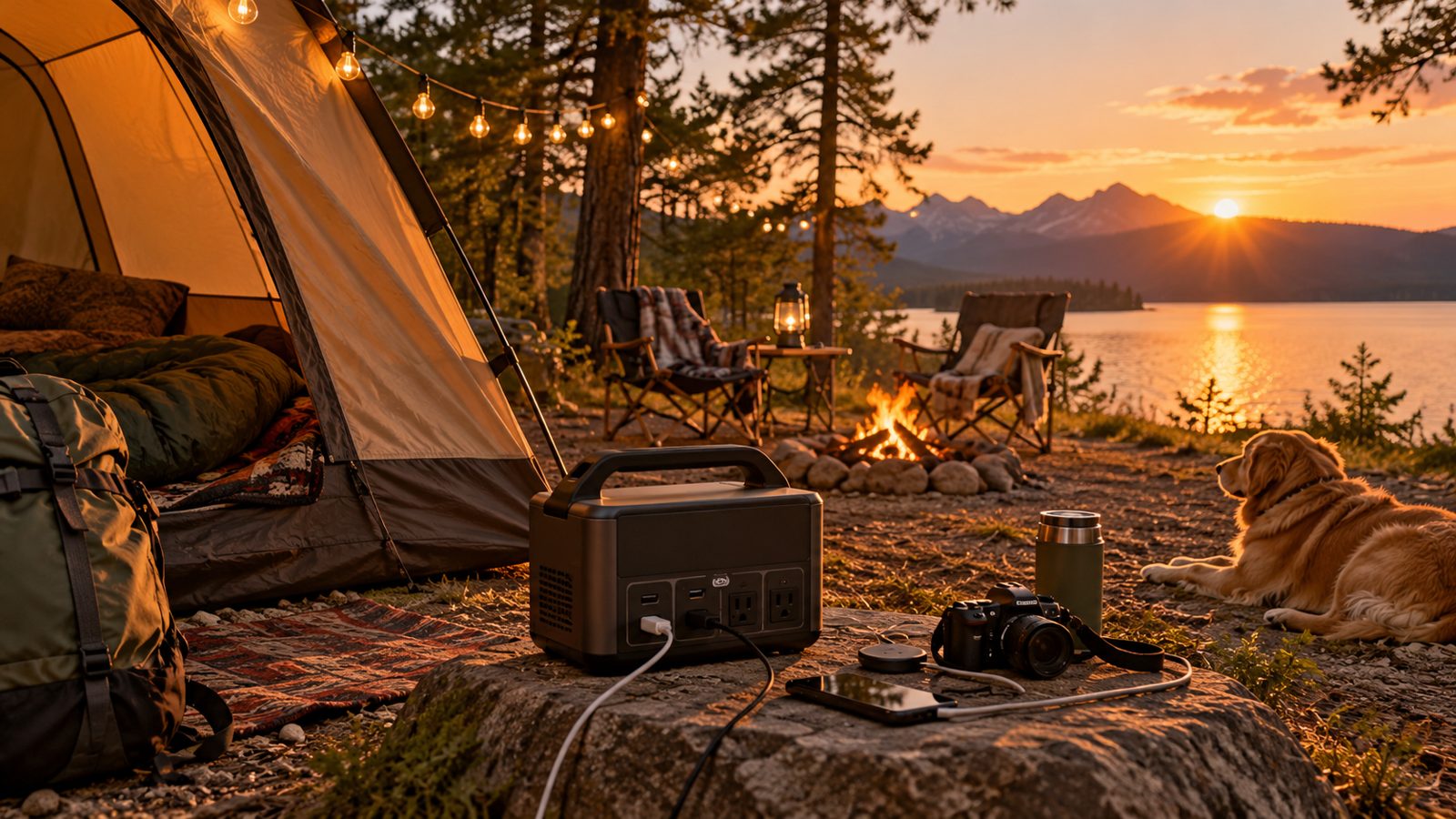
At a campsite, you carry the power station from the car, recharge it while you drive, and sleep next to it. That changes the ranking. A unit that wins for home backup can lose here on weight or fan noise.
Quick picks
- Best for car campingJackery Explorer 1000 v2Check price
- Best for vans and RVsEcoFlow DELTA 3 PlusCheck price
- Most power at campAnker SOLIX C1000 Gen 2Check price
- Best valueBLUETTI AC180Check price
Compared for the road
| Spec | Top pickJackeryExplorer 1000 v2 | Vans and RVsEcoFlowDELTA 3 Plus | Most powerAnker SOLIXC1000 Gen 2 | Best valueBLUETTIAC180 |
|---|---|---|---|---|
| Best for | Light weight for a 1kWh unit | Fast recharging and expandable home backup | Highest output in the 1kWh class | Budget-conscious buyers who want 1kWh+ |
| Capacityhigher is better | 1,070 Wh1,070Wh | 1,024 Wh1,024Wh (expandable to 5kWh) | 1,024 Wh1,024Wh | 1,152 Wh★ Best1,152Wh |
| Continuous AC outputhigher is better | 1,500 W1,500W (3,000W surge) | 1,800 W1,800W (3,600W surge) | 2,000 W★ Best2,000W (3,000W peak) | 1,800 W1,800W (2,700W power lifting) |
| Max solar inputhigher is better | 400 W2 × 200W (400W total) | 1,000 W★ Best2 × 500W (1,000W total) | 600 W600W (60V max) | 500 W500W (12–60V) |
| Weightlower is better | 23.8 lb★ BestAbout 23.8 lb (10.8 kg) | 27.6 lb27.6 lb (12.5 kg) | Not listed | 35.3 lbAbout 35.3 lb (16 kg) |
| Wall charging | About 1.7 h standard | 1,500W (0–100% in 56 min, maker figure) | 1,600W (full in 49 min, maker figure) | 1,440W turbo (≈1.3–1.8 h) |
| Warranty | 3 + 2 years | 5 years | See Anker listing | 5 years |
| Price | Check price | Check price | Check price | Check price |
Specs from each manufacturer's US product page. Bars compare each spec against the best value in this table; they are not test scores. Prices change often, so we link out instead of quoting them.
The picks
★Best for car camping
JackeryExplorer 1000 v2
Best for: Light weight for a 1kWh unit
A 1,070Wh LiFePO4 station rated at 1,500W, weighing about 23.8 lb, with app control and a 3-year warranty extendable to 5.
What we like
- Lightest unit in this group
- Very quiet fan (≤22 dB, maker figure)
- Simple layout
Watch out for
- Only three AC outlets
- Solar input tops out at 400W
- Not expandable
The Explorer 1000 v2 is the easiest of the four to haul from trunk to picnic table, at about 23.8 lb. Jackery lists its fan at 22 dB or less, which helps in a quiet campground. Two 200W solar inputs fit a pair of portable panels well. As with every unit here, a 12V car socket refills it slowly, so plan to top up at camp with solar.
★Best for vans and RVs
EcoFlowDELTA 3 Plus
Best for: Fast recharging and expandable home backup
A 1,024Wh LiFePO4 unit with 1,800W AC output, 1,500W wall charging and the option to add extra batteries for up to 5kWh.
What we like
- Two solar inputs totaling 1,000W
- Expands with extra battery packs
- Quiet below 600W (30 dB, maker figure)
Watch out for
- At 27.6 lb, about 4 lb heavier than the Jackery
- Expansion batteries cost extra
The DELTA 3 Plus accepts 1,000W of solar across two inputs, the most in this group and enough for a roof array on a van. EcoFlow lists its fan at 30 dB under 600W of load. Extra batteries take you to 5kWh for longer trips, and EcoFlow sells an alternator charger add-on for vans; check its install requirements first.
★Most power at camp
Anker SOLIXC1000 Gen 2
Best for: Highest output in the 1kWh class
A 1,024Wh LiFePO4 unit with 2,000W continuous output, 1,600W HyperFlash recharging and up to 600W of solar input.
What we like
- 2,000W continuous output
- Fast 49-minute wall recharge (app setting)
- TOU scheduling in the app
Watch out for
- Fast charging must be switched on in the app
- Not expandable
With 2,000W continuous output, the C1000 Gen 2 handles a 1,800W induction burner or an electric kettle more comfortably than the other three. Anker lists up to 600W of solar input and a 49-minute HyperFlash wall recharge, useful when you stop at a campground with hookups.
★Best value
BLUETTIAC180
Best for: Budget-conscious buyers who want 1kWh+
A 1,152Wh LiFePO4 station with 1,800W output, 1,440W turbo AC charging and a built-in 15W wireless charging pad.
What we like
- $499 list price on BLUETTI US (checked Oct 27, 2026)
- Wireless charging pad
- 5-year warranty
Watch out for
- Heaviest of the 1kWh-class group
- Not expandable (power-bank mode only)
- Must stay upright
The AC180 holds the most energy in this group, 1,152Wh, and includes a 15W wireless charging pad for phones. At 35.3 lb it is the heaviest, and BLUETTI says to keep it upright, so pack it where it will not tip over in the cargo area.
A simple camping power budget
| Device | Watts | Hours/day | Wh/day |
|---|---|---|---|
| LED string lights | 10 | 5 | 50 |
| Phones (2) | 15 | 3 | 45 |
| Camera batteries | 20 | 2 | 40 |
| Fan | 25 | 8 | 200 |
| CPAP, no humidifier | 40 | 8 | 320 |
| Total | 655 |
Divide by 0.85 for inverter losses and you get about 770Wh per day. Any of the four covers one day; for a three-day trip without hookups you would need about 400W of panels to keep up, or a bigger battery. Skip AC power where you can: running a CPAP or fan from a 12V or USB-C port avoids inverter losses.
Before you go
- Charge the station to 100% the night before, and set it to charge from solar as soon as you arrive.
- Keep it in the shade. Every maker lists a maximum charging temperature, and a closed car in summer can pass it.
- Bring the right cable for your panels. Solar connectors differ by brand, so confirm the plug type on the spec page before you buy third-party panels.
For home outages rather than trips, see our best portable power stations for home backup. To plan panels, read the solar generator buying guide.
Frequently asked questions
What size power station do I need for camping?
For a weekend of lights, phone charging, a fan and a 12V fridge, 500Wh to 1,000Wh usually works. A 12V compressor cooler often uses a few hundred watt-hours a day, depending on heat and how often you open it. If you run a CPAP or an induction cooktop, go 1,000Wh or larger.
Can I charge a portable power station from my car?
Yes, all four accept car charging, but a standard 12V socket supplies only around 100W, so a full refill of a 1kWh unit takes most of a day of driving. Check the maker spec page for the exact car-input rating before you rely on it.
Can a portable power station run an RV air conditioner?
Usually not for long. A rooftop RV air conditioner draws well over 1,000W running and more to start, so a 1kWh station would last about an hour at best. For air conditioning, plan on a large battery system or a generator.
Is it safe to use a power station inside a tent?
A battery power station burns no fuel, so it gives off no carbon monoxide. Keep it off wet ground, out of direct rain and away from bedding that blocks its vents. Never bring a gas generator or fuel heater into a tent.